

Stravinsky: The Soldier’s Tale Retold & Histoire du soldat Suite - Art of Time Ensemble & Andrew Burashko
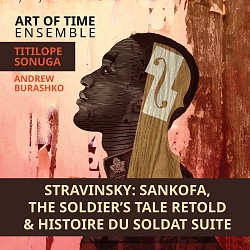
 Stravinsky: The Soldier’s Tale Retold & Histoire du soldat Suite
Art of Time Ensemble & Andrew Burashko
LM304 (leaf-music.lnk.to/lm304c)
Listen
Sankofa, The Soldier's Tale Retold, Pt. 1: VI. The Soldier's March (Reprise)
Histoire du soldat Suite, K029, Pt. 2: VIIIc. 3 Dances. No. 3, Ragtime
Histoire du soldat Suite, K029, Pt. 2: IX. The Devil's Dance
Read the Review
As Torontonians learned several years ago when Dundas Square was renamed, the word Sankofa, originating from the Akan people of Ghana, comes from a Twi expression whose literal meaning is “Go back and get it!” a command to pay due regard to the lessons and practices of the past and to draw on them to inform the present and the future. The symbol of Sankofa, is often depicted as a bird with its feet facing forward (progress) while its head is turned backward (reflection), carrying a precious egg in its mouth (future/wisdom).
In October 2024 the Art of Time Ensemble produced Sankofa: The Soldier’s Tale Retold under Andrew Burashko’s direction, Nigerian-Canadian poet Titilope Sonuga’s reimagining of Stravinsky’s L’Histoire du Soldat. As their contribution to this year’s Black History Month Leaf Music released a recording of this stunning work (LM304 leaf-music.lnk.to/lm304c).
The original story by Charles-Ferdinand Ramuz told of a First World War soldier who encounters the devil to whom he barters his violin for the promise of eternal riches, a bargain that has dire consequences. Sonuga’s version tells of a (fictional) Jamaican man of African heritage in Halifax in 1914 who wants to enlist in the Canadian army but is turned down because people of his skin colour are not welcome to join. He meets the devil who cajoles him into accepting a magic violin in exchange for his bird amulet, a gift from his mother. “Sankofa, is what he calls the bird, who holds his history in a word. A symbol, an ancient guide, resting near his heart with pride.” With the devil’s help he is accepted into the only entirely black battalion in the Canadian army, the historical No.2 Construction Battalion, which suffered abuse at the hands of their white officers and was relegated to digging ditches because their commanders refused to give them arms.
Spoiler alert: As in the original, and many other such tales, selling your soul to the devil never turns out well, although there are a number of exhilarating moments along the way.
Stravinsky’s music is used throughout the hour-long performance. Burashko says “I asked [Sonuga for] an homage to the original in the following ways: that the libretto be written in rhyming verse; for the same characters (Soldier, Devil and Narrator); that it follow the original structure by having the Devil appear in different guises and that the new libretto make perfect sense with the original music.” It does indeed, and also makes for a powerful story.
The skeletal orchestration – violin, clarinet, trumpet, trombone, bassoon, double bass and percussion – is said to represent the scarcity of musicians in Stravinsky’s Paris in the wake of the devastation of WWI. The excellent members of the Art of Time Ensemble, led by violinist Benjamin Bowman, capture the score brilliantly, and the actors – Ordena Stephens-Thompson (Narrator), Olaoluwa Fayokun (Soldier) and Diego Matamoros (Devil) – bring the story compellingly to life. The jam-packed disc also includes a stellar performance of the 28-minute instrumental suite that Stravinsky extracted from L’Histoire. Kudos to all concerned.